Nasal intubation is an airway management technique with uses in surgical settings that require access to the mouth or throat while maintaining ventilation and a controlled patient airway. Because the endotracheal tube is passed through the nasal cavity rather than the mouth, the oral cavity is left completely unobstructed (Prasanna & Bhat, 2014).
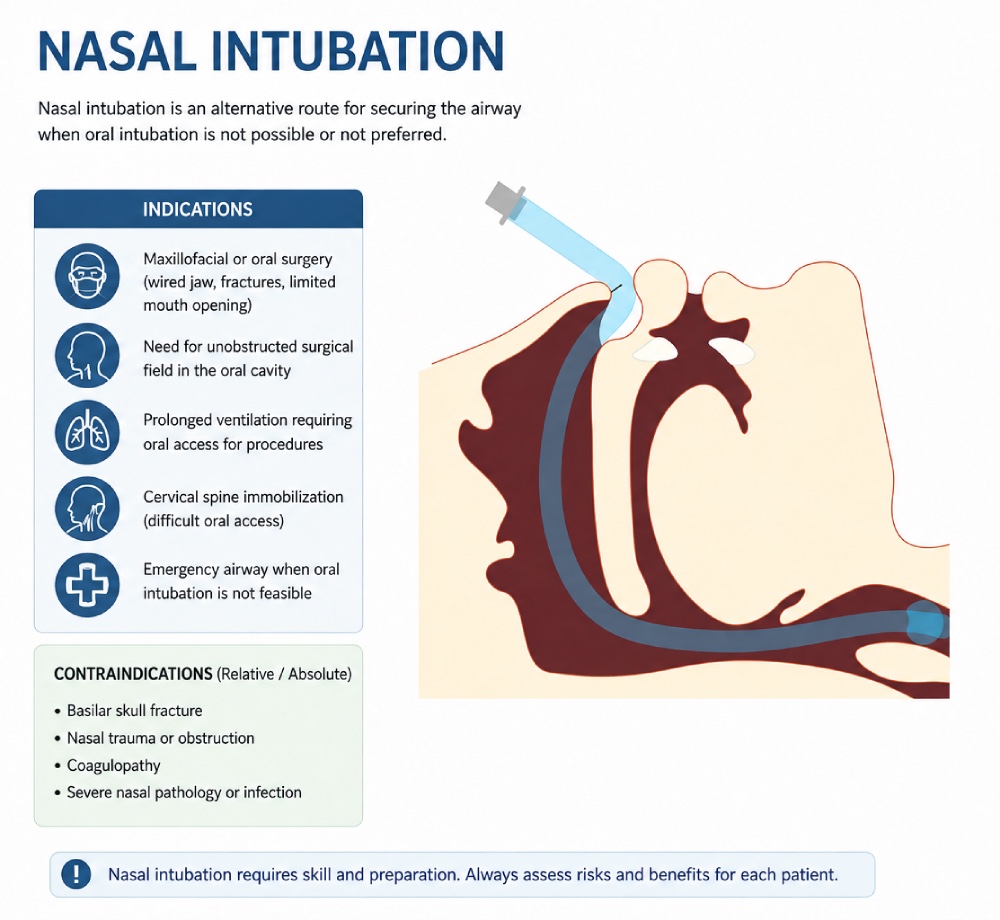
The most frequent indication for nasal intubation is intraoral and maxillofacial surgery. Procedures involving the mandible, dental arches, palate, and oropharynx require unimpeded surgical access, and an orotracheal tube would physically interfere with the operative field. Nasal intubation is therefore the preferred route for orthognathic surgery, dental restorative work under general anesthesia, tonsillectomy, and other head and neck procedures where the surgeon must work within or across the mouth (Prasanna & Bhat, 2014; Park et al., 2021). Rigid laryngoscopy and microlaryngeal surgery are cited for the same reason: the tube must be kept clear of the operative corridor (Prasanna & Bhat, 2014).
A second major indication arises when the oral route is simply not available. Trismus, whether from temporomandibular joint pathology, infection, radiation fibrosis, or trauma, can make mouth opening insufficient for oral intubation or even for direct laryngoscopy. In these circumstances, the nasal route allows the tube to bypass the oral cavity altogether, and fiberoptic-guided nasal intubation has become a mainstay for securing the airway in patients with severely restricted mouth opening or a difficult airway more broadly (Park et al., 2021; Prasanna & Bhat, 2014).
Nasal intubation is also used in critically ill and intensive care patients as an alternative to tracheostomy when ventilatory support is needed but a surgical airway is not yet warranted (Prasanna & Bhat, 2014). More broadly, nasotracheal tubes are considered easier to fix and stabilise through the relatively narrow nasal passage than through the oral cavity, which can be advantageous for airway security during longer periods of ventilation or in patients who are difficult to reposition, including some trauma and critically ill populations (Park et al., 2021). It should be noted, however, that ICU intubation in general carries a substantially higher rate of difficult and complicated intubation than intubation performed in the operating theater, a factor that must be weighed regardless of the route chosen (Heuer et al., 2012).
Technique selection within nasal intubation is tailored to the clinical indication. Blind nasal intubation, once the default approach before adjuncts such as the laryngoscope and Magill forceps were available, has largely been superseded but may still be used by experienced operators in spontaneously breathing patients when other equipment is unavailable (Park et al., 2021; Heuer et al., 2012). Fiberoptic nasal intubation is now regarded as the gold-standard method for anticipated difficult airways, as it allows the endotracheal tube's path to be visualized in real time, reducing the risks associated with blind passage through the nasal cavity while also serving a diagnostic role in assessing intranasal anatomy (Prasanna & Bhat, 2014; Park et al., 2021).
Because the tube must traverse a comparatively narrow and vascular passage, tube design also influences suitability for a given indication. Reinforced and flexible tubes are more likely to follow the safer lower nasal pathway, along the floor of the nose beneath the inferior turbinate, than are rigid preformed tubes, and this has direct implications for reducing epistaxis and turbinate trauma during use (Ahmed-Nusrath et al., 2008).
The uses of nasal intubation include maxillofacial, dental, and head and neck surgeries where clear access to the oral cavity is needed, as well as other situations where the patient requires airway support but oral intubation is contraindicated. It is chosen principally for the surgical field it preserves and the airway options it provides when the oral route is compromised, rather than as a universally preferred method of airway management.